
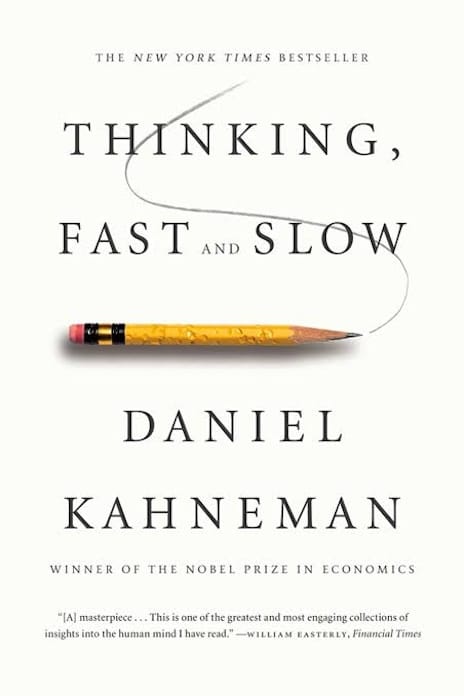
Thinking, Fast and Slow
Author: Daniel Kahneman
About:
In the international bestseller, Thinking, Fast and Slow, Daniel Kahneman, the renowned psychologist and winner of the Nobel Prize in Economics, takes us on a groundbreaking tour of the mind and explains the two systems that drive the way we think.
System 1 is fast, intuitive, and emotional; System 2 is slower, more deliberative, and more logical. The impact of overconfidence on corporate strategies, the difficulties of predicting what will make us happy in the future, the profound effect of cognitive biases on everything from playing the stock market to planning our next vacation—each of these can be understood only by knowing how the two systems shape our judgments and decisions.
Engaging the reader in a lively conversation about how we think, Kahneman reveals where we can and cannot trust our intuitions and how we can tap into the benefits of slow thinking. He offers practical and enlightening insights into how choices are made in both our business and our personal lives – and how we can use different techniques to guard against the mental glitches that often get us into trouble.
(Credit: Book Cover)
Amy’s Takeaway
When I first picked up this book, I was overwhelmed by its volume and the resume of its author. I was studying the decision making of school superintendents as a doctoral student. The book was recommended to me at every turn as a seminal work on why people choose one course or option over another.
As daunting as it first seemed, the book reads more like a collection of stories since I could see humanity in Kahneman’s writing. Now let me be clear, the author’s stories aren’t short stories. They’re complex. They’re thick. But they’re also fascinating. Being a Nobel Prize winner and still able to break down elaborate theories for ordinary folks is a rare gift.
We can all easily think of dozens of times when our biases, hasty thinking, or misframing a situation led us into a mess. Sometimes, I rinse and repeat the same mistakes because I haven’t figured out the code to why I made the error in the first place. This book isn’t a cure-all, as free will always remains. However, it does give us a bright flashlight to examine the way we each make decisions.
For example, Kahneman explores the endowment effect, which describes how people tend to value items they own more highly than they would if they didn’t belong to them. Have you ever had a garage sale and found yourself pricing a toy higher than is reasonable because you remember your child playing with it in the living room? That’s the endowment effect in action. The toy has additional worth because your story is attached to it.
Additional theories and concepts abound in Thinking, Fast and Slow. The comparison between Systems 1 and Systems 2 thinking left me spellbound. It’s the difference between first impressions and actually getting to know someone. As a society, we tend to celebrate quick thinkers. Kahneman presents ample evidence that makes us reconsider whether quicker is always better or wiser.
This book probably isn’t your light, beach-chair read. But if you find yourself frustrated by the “whys” of your own decision making and those around you, I bet you’ll find the pages full of objective, research-based answers to your questions. At the very least, you’ll be more humble and a smidge wiser after each chapter. Kahneman’s brilliance and his ability to use parable-esque storytelling serve us all well and likely will for generations to come.
Words of Wisdom from the Author
“The premise of this book is that it is easier to recognize other people’s mistakes than our own.”
“One of the tasks of System 2 is to overcome the impulses of System 1. In other words, System 2 is in charge of self-control.”
“A reliable way to make people believe in falsehoods is frequent repetition, because familiarity is not easily distinguished from truth.”
“The often-used phrase ‘pay attention’ is apt: you dispose of a limited budget of attention that you can allocate to activities, and if you try to go beyond your budget, you will fail.”
“Indeed, there is evidence that people are more likely to be influenced by empty persuasive messages, such as commercials, when they are tired and depleted.”
“Nothing in life is as important as you think it is when you are thinking of it.”