
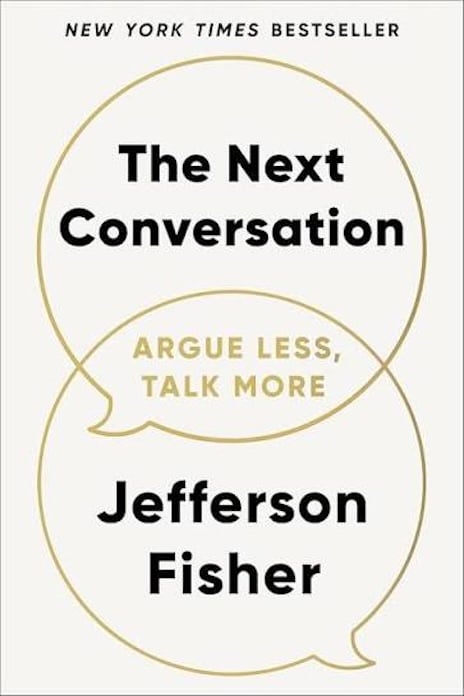
The Next Conversation
Author: Jefferson Fisher
About: No matter who you’re talking to, The Next Conversation gives you immediately actionable strategies and phrases that will forever change how you communicate. Jefferson Fisher, trial lawyer and one of the leading voices on real-world communication, offers a tried-and-true framework that will show you how to transform your life and your relationships by improving your next conversation.
Fisher has gained millions of followers through short, simple, practical videos teaching people how to argue less and talk more. Whether it’s handling a heated conversation, dealing with a difficult personality, or standing your ground with confidence, his down-to-earth teachings have helped countless people navigate life’s toughest situations.
Your every word matters, and by controlling how you communicate every day, you will create waves of positive impact that will resonate throughout your relationships to last a lifetime.
(Credit: Book Jacket)
Amy’s Takeaway
If you’ve followed me for a bit, you know I’m a planner and try to be a strategic thinker. That all sounds good on the surface, but presents challenges in conversations. If you’re at all like me, you may have done this in advance of a conversation. Well, if they say this, then I’ll say this, and then if they say that, I’ll say that. My motives are good ones. I want to be kind and thoughtful as well as an agent of peace, if possible. Here’s the problem with my formerly used approach. It never works. It’s this weird sort of control where we think if we plan enough, we can keep from hurting someone else’s feelings or accomplish goals more efficiently. We think if we ruminate on the upcoming conversation long enough, we can be prepared for anything the other person says.
That logic trail is flawed. We only have the potential to control our own words and not anyone else’s. I say potential because, if we’re similar, there are times when something comes out of my mouth and I wonder, “What in the world?!”
My daughter read The Next Conversation and gave it to me as a gift. I had never heard of the book, and I’m beyond grateful she thought of me. Jefferson Fisher writes from the paradigm of being a learner. His humility and curiosity resonated with me, so I felt as if a trusted friend was coaching me. It’s a little weird to read some of his examples in the book, as it felt like Fisher was in the conference room or at the breakfast table with me, hearing my conversations! It was a good reminder that we all struggle to communicate clearly.
Fisher’s advice is doable. Today. The bite-sized pieces he provides give you phrases and simple statements that bear fruit – sometimes the first time you use them.
When I see another adult struggling or negatively impacted by my words, I’m tempted to keep talking and try to guide them out of their struggles. As a mom, I didn’t do that with our children because I knew learning sometimes comes with a struggle. The difference probably speaks to my insecurities.
As I’ve applied many of Fisher’s strategies, I’ve enjoyed more freedom and joy in my conversations. I’m learning that I’m not really trusting the other side of the conversation to a person – I’m trusting it to God. My potential to learn more is why The Next Conversation is on my “read again” list.
Words of Wisdom from the Author
“Have something to learn, not something to prove.”
“You’re living in a world of transmission, not connection. Transmission conveys information, but connection breathes life into it.”
“When even your own thoughts are treated like an inconvenience, you’ll find yourself beginning to hide from the very interactions that could bring out the best in you.”
“What triggers you teaches you – if you’re willing to learn.”
“The concept of confidence you’re likely more familiar with from your past prioritizes perfection. The version of confidence I’m asking you to adopt moving forward prioritizes grace.”
“The fastest way to lose your peace of mind is to give someone a piece of yours.”
“How you handle a difficult conversation says more about your character than the content of the conversation itself.”