
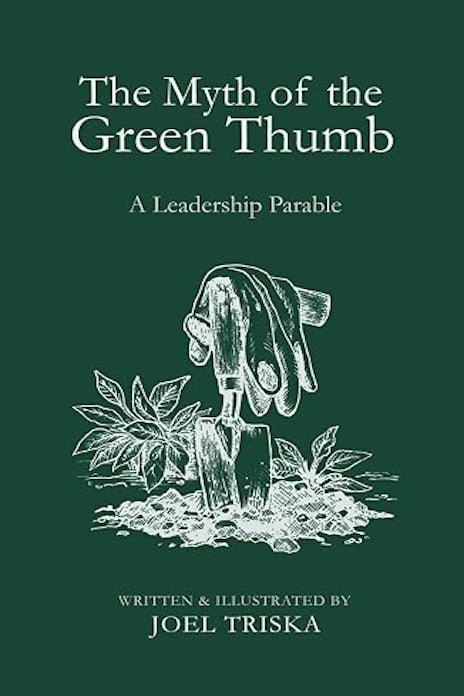
The Myth Of The Green Thumb
Author: Joel Triska
About: Leadership growth is not about having a green thumb.
When Julia Hartman inherits her grandmother’s greenhouse, she is already respected, successful, and quietly exhausted. What begins as a reluctant return to Cedar Ridge becomes an unexpected lesson in growth – of plants, people, teams, and herself.
The Myth Of The Green Thumb is a leadership fable about attention, trust, accountability, and the patience to create conditions where people can thrive.
For leaders, coaches, managers, and teams learning to trade control for cultivation.
(Credit: Book Cover)
Amy’s Takeaway
A parable is the perfect tool for Joel Triska to teach us, or remind us, about the essence of exceptional, high-character leadership. Triska uses a plausible character, Julia Hartman, and the relatable stress of her business dilemmas as a platform for lessons on guiding others well. A parable’s simplicity makes it easy to understand. A parable’s purpose makes it worth remembering.
If you have ever felt exhausted, burned out, or questioned your own discernment, this book will give you hope with a dollop of mentoring. We can’t control other people’s choices. But Triska does something remarkable: he creates openings where we can see that, even amid the most dismal situations or when others behave badly, we still have options.
Decision making is a non-negotiable requirement of leadership. Although I wish at times they were, decision paths aren’t written on a wall with a Sharpie. The gift Triska provides is a crystal-clear mirror that lets us examine our own motives as he walks us through Julia’s decision-making landmines. With every step, she has an opportunity to clarify which value in her life takes priority.
Mr. Alvarez, who has been keeping an eye on Julia’s inherited greenhouse, proves to be a partner and sage, discussing plants and people with her. Through their dialogue, Triska compares the two, with growth as a central theme. As leaders, we can hyperfocus on the growth of those around us. Yet we often realize that the greatest growth is our own.
A plant is probably not the first thing Julia would think of as her next leadership mentor. Triska’s artfully constructed story reminds us that teachable hearts will always find lessons about leading well if curiosity remains. A tenacious leader, like Julia, strives until her decisions reflect her character.
This book is sprinkled with reflections and journal entries worth revisiting. As an educational leadership instructor at the university level, I found myself thinking about ways to gift Triska’s book to grad students. While courses have plenty of technical content, nothing supersedes training leaders to think about the people they serve and serve with.
No matter your profession, if you tell yourself you’re not a leader, I would challenge that notion. If you influence employees, children, or anyone else, you are indeed a leader and this book is for you. Throughout the parable, Triska walks you through a greenhouse of life lessons and into the hearts of those you serve.
Words of Wisdom from the Author
“Reaction faces the problem. Response faces the purpose.”
“We do not have to be strong all the time. Things wilt when they are tired. This is not failure. This is a request for attention.”
“Things grow when they’re ready. Not when you get impatient.”
“Tending isn’t glamorous. It’s what keeps things going when no one’s watching.”
“Weather changes more often than we do. Pay attention to what bends, and what refuses to break. Some storms only mean this: what you’ve planted may have deeper roots than you think.”
“Leaders check their footing before they tell others where to step.”